Real-World Shared-Nothing Architectures in Action 🌍✨
Exploring systems that leverage Shared-Nothing design to scale, stay resilient, and avoid bottlenecks.

🚀 Introduction
Ever wondered how large-scale systems like Google or Netflix manage to stay fast and resilient, even during traffic surges? Let’s dive into the realm of scalable and resilient systems with Shared Nothing Architecture (SNA)! This design paradigm revolutionizes how data is processed, stored, and accessed in distributed systems. If you're new to SNA, start with our introductory article What is Shared Nothing Architecture (SNA)? that covers its fundamentals. Let’s dive into some real-world examples, uncover lessons learned, and discuss the trade-offs.
Understanding Shared Nothing Architecture
At its core, SNA is about giving every node in a system complete autonomy. No sharing, no bottlenecks. Here’s a quick breakdown:
SNA in a Nutshell:
🛠 No Shared Resources : Each node has its own CPU, memory, and storage.
🗺 Decentralized Control : No single point of failure.
📈 Horizontal Scaling : Need more power? Just add more nodes.
Why Should You Care?
SNA powers some of the largest systems on the planet. Its benefits include:
Scalability : Adding nodes means more capacity, linearly.
Fault Tolerance : If one node crashes, the rest keep humming.
Cost Efficiency : Commodity hardware delivers amazing results.
👉 Pop Quiz: What’s your biggest challenge when scaling systems? (e.g., consistency, cost, latency)
Case Studies: Where Shared Nothing Shines
Let’s explore some systems that have embraced SNA (or come close).
1. Apache Cassandra
What It Does: Distributed NoSQL database.
How It Applies SNA:
Data is partitioned across nodes.
Each node is autonomous with no central coordinator.
Replication ensures fault tolerance.
Benefits: High availability, scalability, and low latency.
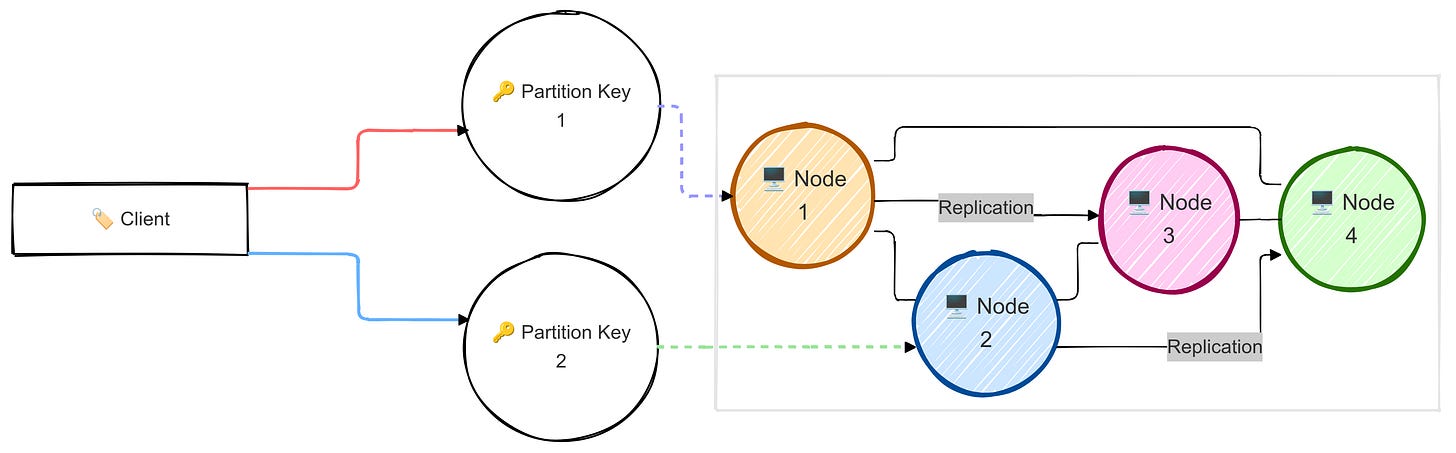
Cassandra: Leveraging Shared Nothing Architecture for Scalable Data Partitioning
Fun Fact: Netflix uses Cassandra to manage billions of user-generated events daily!
💡 Interactive Challenge: Imagine you’re designing a system for global e-commerce. Would you prioritize high availability (like Cassandra) or strong consistency? Why?
2. Google’s MapReduce (Early Implementation)
What It Does: A framework for processing large datasets.
How It Applies SNA:
Data is divided into chunks and processed independently.
Each node works autonomously to ensure scalability.
Benefits: Handles petabytes of data efficiently.
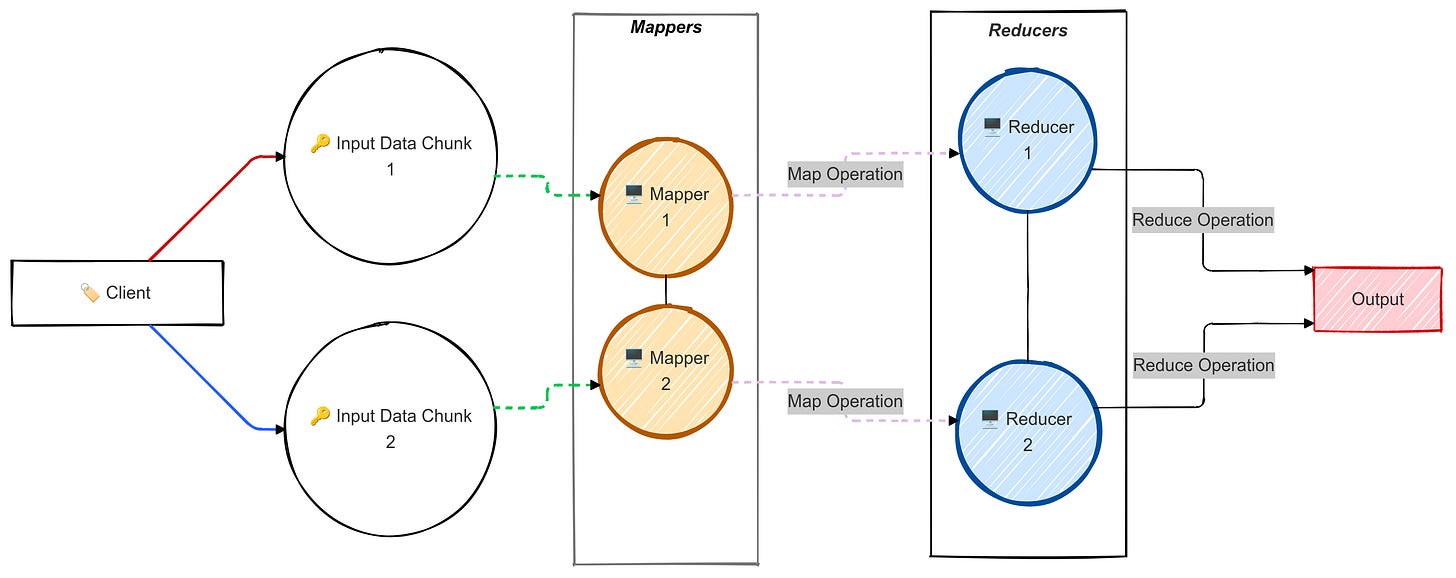
Autonomous Mappers and Reducers : MapReduce Meets Shared Nothing Architecture.
Thought Experiment: If you had unlimited storage but limited compute resources, how would you optimize processing in a system like MapReduce? Share your ideas below!
Partially SNA or Inspired Implementations
Not every system strictly adheres to SNA principles, but many borrow heavily from them to enhance scalability and resilience.
1. Google’s BigTable
SNA Features: Data is partitioned and distributed across autonomous nodes, ensuring scalability.
Deviation: A centralized master node manages metadata, introducing a single point of control.
Real-World Use: Supports critical Google services like Maps and Gmail, demonstrating its efficiency for high-demand applications.
2. Amazon DynamoDB
SNA Features: Automatically partitions and distributes data to handle massive workloads.
Deviation: Employs some centralized coordination to streamline scaling and consistency.
Real-World Use: Ideal for high-velocity workloads like online retail and IoT, where low latency is critical.
3. Apache Hadoop’s HDFS & Spark
SNA Features: Nodes in the cluster store and process data independently, embodying SNA-inspired distributed principles.
Deviation: Relies on centralized components like the NameNode (HDFS) or the driver node (Spark) for orchestration.
Real-World Use: Forms the backbone of big data pipelines, managing large-scale storage and computation effectively.
📣 Let’s Discuss: What’s more important in these systems: scalability or simplicity? Drop your thoughts below!
Lessons Learned from SNA Implementations
Scalability is Key : Systems can grow without major overhauls.
Fault Tolerance Matters : Autonomous nodes minimize downtime and improve resilience.
Trade-Offs Exist : Complexity often accompanies decentralization, requiring careful design.
Trade-Offs and Challenges
While Shared Nothing Architecture offers numerous benefits, it also presents challenges:
Development Complexity Designing truly autonomous nodes can be complex:
Apache Cassandra's distributed architecture requires careful configuration to ensure optimal performance and data distribution.
Google's BigTable needs to balance centralized metadata management with decentralized data storage.
Consistency Issues Balancing consistency and availability (CAP theorem) can be tricky:
Amazon DynamoDB uses eventual consistency to ensure high availability, but may lead to stale data in some cases.
Apache HBase provides strong consistency, but may sacrifice availability during network partitions.
Network Bottlenecks Inter-node communication can slow down systems:
Apache Hadoop's shuffle phase requires heavy inter-node communication, potentially causing network bottlenecks.
Apache Spark's RDD (Resilient Distributed Dataset) operations can lead to increased network traffic.
Additional Challenges
Data partitioning: Ensuring even data distribution across nodes can be challenging (e.g., Apache Cassandra's partition key design).
Fault tolerance: Implementing robust fault tolerance mechanisms can add complexity (e.g., Google's MapReduce's checkpointing).
Best Practices for Implementing SNA
If you’re ready to embrace SNA, here’s how to get started:
Plan for Scalability: Design for horizontal growth from day one.
Optimize Partitioning: Avoid data hotspots by evenly distributing workloads.
Monitor Continuously: Keep tabs on performance metrics and fault tolerance.
Conclusion
Shared Nothing Architecture is more than a buzzword—it’s a powerful strategy for building scalable, resilient, and efficient systems. From enabling Netflix’s global reach to processing Google’s vast datasets, SNA has proven its worth.
📣 What are your thoughts on SNA? Share your insights, stories, or questions in the comments—let’s learn together!


